💯 Tested and Working Product 🛡️ Clean & Secure 🔒 Safe & Secure Payments 📥 Instant Direct Downloads 🔄 Regular Product Updates
Elementor PRO plugin

Elementor PRO 4.3.0 – WordPress Plugin Page Builder

Version: 4.3.0 Update?
Updated: Sep 22, 2026 Archive Scan:Clean
Developer Website
Genuine Release
100% genuine files directly from the developers. Licensed under the GNU GPL for an unlimited number of sites.
Technical Support
Professional help in solving any technical problems. Support is included in the price. Read the Support Policy.
Guarantees and Safety
100% safe & team-verified before publishing. Eligible for a 30-day refund in accordance with our Refund Policy.

Elementor Pro is not “a theme builder”. It’s an add-on that unlocks the parts of Elementor that matter on real client work: Theme Builder, WooCommerce Builder, Popup Builder, Forms, dynamic data, and a bunch of Pro widgets. If you already live in Elementor Free, Pro is the difference between “I can design pages” and “I can control the whole site without touching PHP templates”.

I use it when I need to ship a custom layout fast, but still keep things maintainable: header/footer, single templates, archives, custom post types, and Woo templates all in one place. If your plan is a lightweight custom theme with a few Gutenberg blocks — you don’t need Pro and you’ll hate the extra moving parts.

How it works (so you know what you’re signing up for)

Elementor stores layouts as JSON in post meta and manages reusable parts via the elementor_library post type (templates, theme parts, popups). CSS is generated into files under wp-content/uploads/elementor/css/. That’s why “it looked fine yesterday, broken today” often ends with Regenerate CSS & Data and a cache purge.

Theme Builder / Woo Builder don’t magically “replace WordPress”. They override output by hooking into template loading and WooCommerce template parts. If your theme hardcodes headers/footers or heavily rewrites Woo templates, you’ll feel friction.

GPL reality (what works without a license key)

Core Pro features work: Theme Builder, Woo widgets, Forms, Popups, dynamic tags — you can build and publish normally.

What you don’t get without your own Elementor Pro license:

  • automatic updates from Elementor’s servers
  • access to premium template kits/library that require account auth
  • vendor support
  • anything tied to Elementor’s cloud/account features (when they’re behind login)

So the workflow is simple: close the activation nag, and update manually by uploading a new ZIP over the existing plugin.

Where people usually break Elementor Pro (and the fast fixes)

1) “Frontend is unstyled / widgets look wrong.”
Almost always stale generated CSS + cache. Fix order:
Elementor → Tools → Regenerate CSS & Data → clear cache plugin → clear server/CDN cache.

2) Popups/forms don’t submit or spin forever.
Security/WAF blocking admin-ajax.php or REST endpoints, or JS delay breaking event handlers. Check DevTools → Network for 403/401. Whitelist the endpoint and disable “Delay JS” for Elementor scripts on that page.

3) Minify/defer breaks sliders, tabs, sticky headers.
If you defer everything, Elementor’s frontend init can run before dependencies. Exclude at least:

  • elementor-frontend
  • jquery-core (for diagnosis; later you can fine-tune)
  • your theme’s main script if it registers Elementor hooks

4) WooCommerce template conflicts.
If a theme or plugin overrides the same Woo template parts (gallery, variations), you get weird behavior: price/image not updating, add-to-cart JS errors. Rule of thumb: let Elementor handle templates, and keep Woo “enhancer” plugins minimal.
Practical FAQ (things devs actually ask)

Use Loco Translate or Poedit. Elementor is translation-ready. For text inside templates, you translate the content itself (or via WPML/Polylang integration).

Upload the new Pro ZIP over the current one (WP Admin or FTP). Then immediately: regenerate CSS/data and clear caches. Don’t edit the plugin files — use hooks or custom code snippets.

Yes. It works fine network-activated or per-site. Just remember templates and global styles are stored per site, not shared.

No. A license key is for updates/support/template cloud access. The builder features themselves run without activation.

WPlend Team

All products undergo thorough moderation before being added to WPlend. We carefully check their functionality, features, compatibility, and performance quality to ensure our catalog contains only verified and up-to-date resources.

Package Verification & Test Notes

Below is our manual testing report for the current version.

Tested Package:elementor-pro-4.3.0.zip
File Hash (SHA-256):463edb7ffc82a5fc394b4f80d09b017f9039abdea915c9a811d01679df3df035
Date & Environment:September 22, 2026 | WP 7.0.1 | PHP 8.4
Core Installation:✅ Passed without errors. No license key required for basic usage.
Limitations & Notes:Auto-updates via WP dashboard disabled.
QA Reviewer:WPlend QA Team (QA-02)

💡 Tested by WPlend QA Team according to our WordPress Plugin and Theme Review Methodology.

Download Previous Versions

If you have purchased this product or hold an active membership, you can download previous versions as they are released.

Installing and Updating Plugins

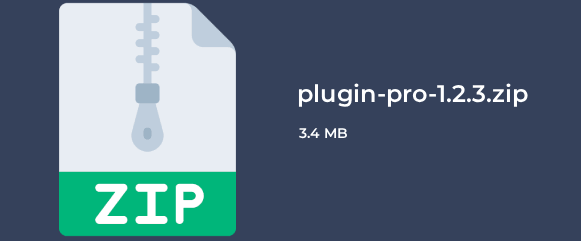
  1. First Installation: Download the plugin's ZIP file from our website.
    ZIP file install plugin
  2. In your WordPress dashboard, navigate to Plugins → Add New Plugin → Upload Plugin.
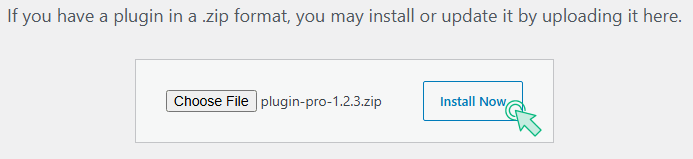
  3. Choose the ZIP file and click Install Now.
    Install Now plugin
  4. Click Activate Plugin.
    Activate Plugin
  5. Updating / Replacing: Navigate to Plugins → Add New Plugin → Upload Plugin.
  6. Choose the ZIP file of the new version and click Install Now.
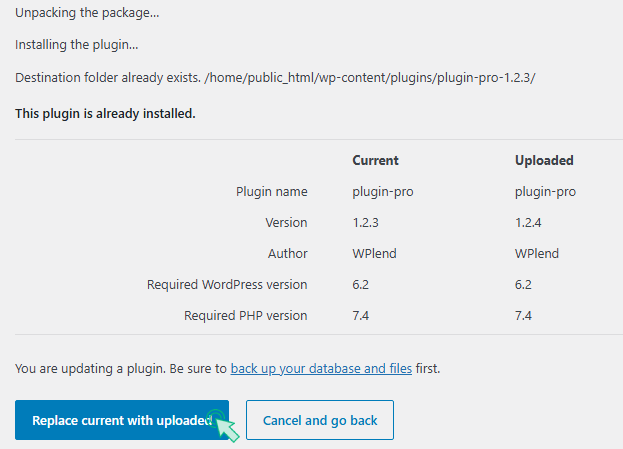
  7. Click the Replace current with uploaded button (reactivate the plugin afterward if necessary).
    Updating plugin
  8. Important Nuances for Plugins:
Bundled packages: If a plugin is supplied as a bundle (core plugin + add-ons), extract the main archive first and install each component separately using its respective ZIP file.
Free version dependencies: Certain PRO plugins (e.g., Elementor Pro, WooCommerce add-ons) require their base free version from the official WordPress repository to be installed and activated on your site beforehand.
File size limits: If WordPress throws an upload_max_filesize limit error, upload the unzipped folder directly via FTP to the /wp-content/plugins/ directory (or /wp-content/themes/ for themes), or use a helper plugin like Easy Theme and Plugin Upgrades.